JSON vs XML vs YAML: Complete Comparison Guide for Developers in 2026
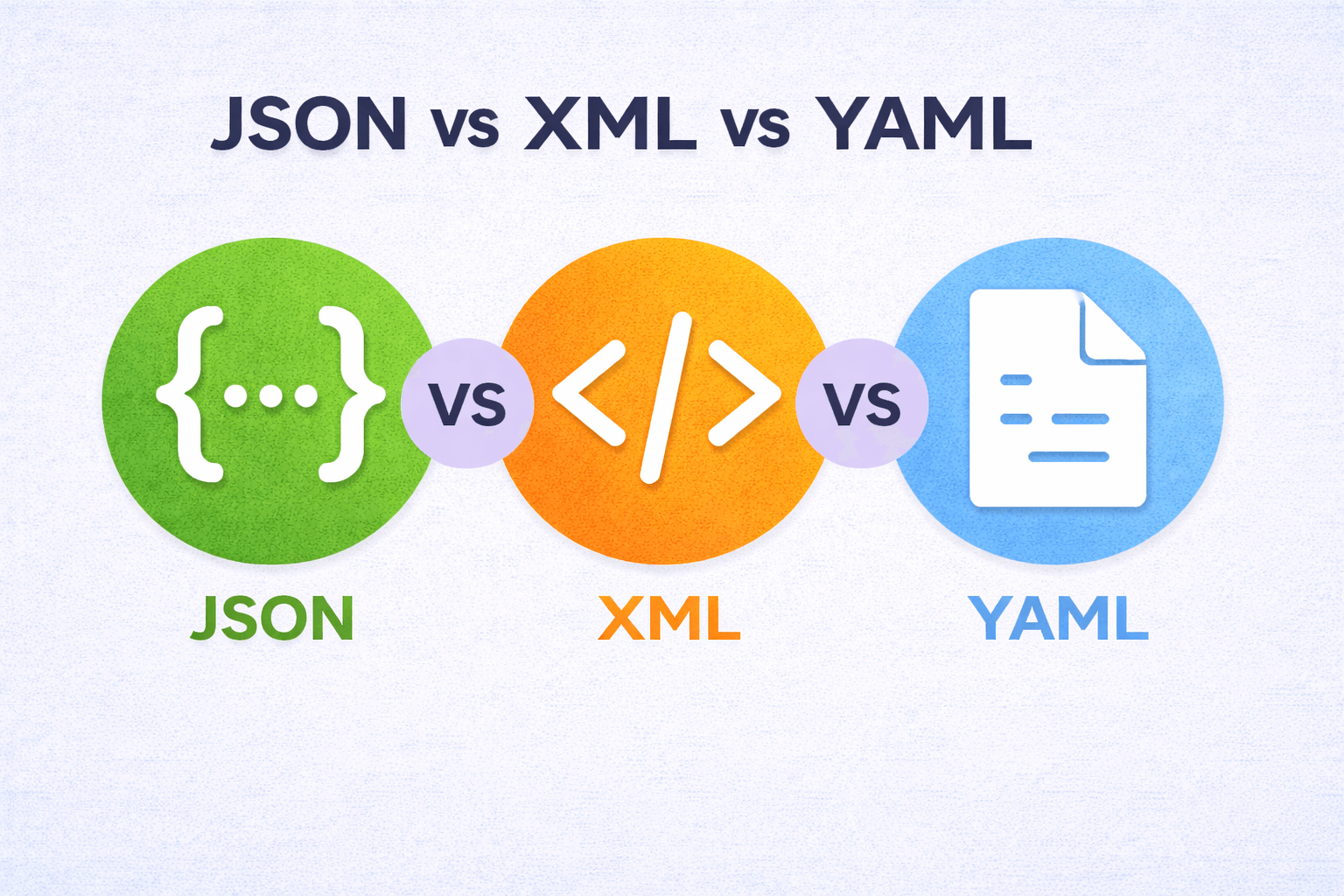
JSON vs XML vs YAML
JSON, XML, and YAML cover most real world data interchange needs in modern software. The right choice depends on what you are building, who consumes the data, and what constraints matter most: speed, validation, readability, or long term compatibility.
This guide compares the practical differences between JSON, XML, and YAML so the format choice is based on trade offs, not habits. It covers syntax structure, parsing performance, human readability, security considerations, and common production use cases.
The examples below reflect common scenarios: API payloads at various sizes (1 KB to 5 MB), configuration file management across teams, data interchange with external systems that require validation, and legacy integration where format translation is part of the work.
JSON: Web's Default Data Interchange Format
JSON (JavaScript Object Notation) is a text based format that uses key value pairs, arrays, and nested objects to represent structured data.
Despite naming, no JavaScript execution involved.
Example structure:
{
  "name": "Imad",
  "age": 22,
  "isDeveloper": true,
  "skills": ["Python", "JavaScript"]
}
JSON dominance stems from direct mapping to programming language data structures. Objects become dictionaries or maps. Arrays become lists. Numbers, strings, and booleans require minimal translation.
JSON Strengths
REST API standard. Web frontend to backend communication overwhelmingly uses JSON.
Browsers parse it natively via
JSON.parse()Additional uses: package manifests (package.json, composer.json), tool configurations (tsconfig.json, .eslintrc.json), NoSQL database storage (MongoDB uses JSON-like BSON format).
Parsing speed excellent. JSON parsers heavily optimized across major languages. Format simplicity reduces processing overhead versus XML's tag-based structure.
JSON Limitations
No comment support is the main developer complaint, especially for configuration files. Explanatory notes cannot live next to a setting. Workarounds like a
_commentJSON has no native date type. Dates get stored as strings, usually in ISO 8601 format, and you have to parse them yourself. This leads to inconsistencies when different parts of a system interpret date strings differently.
For deeply nested data, JSON can become hard to read. All those braces and brackets pile up, and without proper formatting, complex JSON files are genuinely painful to work with.
XML: The Enterprise Veteran
XML stands for Extensible Markup Language. It's been around since the late 1990s and was the dominant data exchange format for years before JSON took over in the web development world.
Here's the same data in XML:
<user>
  <name>Imad</name>
  <age>22</age>
  <isDeveloper>true</isDeveloper>
  <skills>
    <skill>Python</skill>
    <skill>JavaScript</skill>
  </skills>
</user>
Right away you can see it's more verbose. Every piece of data needs an opening and closing tag, which adds bulk. But that verbosity comes with some genuine advantages.
Where XML Shines
XML's biggest strength is schema validation through XSD (XML Schema Definition). You can define exactly what structure your data must follow, what types each field should be, whether fields are required or optional, and even set constraints on values. When you validate an XML document against its schema, you know with certainty that the data conforms to the contract. This matters a lot in enterprise environments where multiple systems exchange data and a malformed message could cause real problems.
XML also supports namespaces, which let you combine data from different schemas in a single document without naming conflicts. This is particularly useful in complex integrations where documents contain data from multiple sources.
Attributes give XML additional flexibility. You can attach metadata to elements directly rather than wrapping everything in child elements:
<book isbn="978-0-13-468599-1" language="en">
  <title>The Pragmatic Programmer</title>
</book>
Enterprise tooling around XML is mature. XSLT for transformations, XPath/XQuery for querying, and SOAP for web services are all well-established technologies with years of production use behind them.
Where XML Falls Short
The verbosity is real and it costs you. XML files are significantly larger than equivalent JSON files, which means more bandwidth, more storage, and slower parsing. For high traffic APIs handling thousands of requests per second, that overhead adds up.
The learning curve is steeper. Understanding namespaces, schemas, CDATA sections, and processing instructions takes time. For simple data exchange tasks, XML is often overkill.
Parsing XML is also more CPU intensive. DOM parsers load the entire document into memory. SAX parsers are event based and more efficient, but they are harder to work with. Either way, it is more work per byte of data compared to JSON.
YAML: Configuration Made Readable
YAML stands for "YAML Ain't Markup Language" (yes, it's a recursive acronym). It was designed with human readability as the top priority, and it shows.
Here's the same data in YAML:
name: Imad
age: 22
isDeveloper: true
skills:
  - Python
  - JavaScript
No braces, no brackets, no quotes around keys. Just clean indentation based structure that reads almost like a bullet point outline.
Where YAML Shines
YAML is the undisputed king of configuration files. If you've used Docker Compose, Kubernetes, GitHub Actions, or any CI/CD pipeline in the last few years, you've written YAML. These tools chose YAML because config files are written and read by humans constantly, and YAML is simply the easiest of the three formats to scan and edit by hand.
YAML supports comments with the # symbol, which is a major advantage over JSON for configuration use cases. You can document why a setting exists right next to it.
It also supports multi line strings cleanly, anchors and aliases (for reusing values), and multiple documents in a single file. These features make it particularly well suited for complex configuration scenarios where you would otherwise have to repeat yourself.
Where YAML Falls Short
YAML's reliance on indentation is both its greatest strength and its most common source of bugs. A single misplaced space can change the meaning of your document, and these errors are notoriously hard to spot. It is common for CI pipelines to fail because of a tiny indentation issue that looks perfectly fine at first glance.
YAML parsing is slower than JSON parsing. The spec is complex (much more so than most people realize), and parsers have to handle a lot of edge cases. For high volume data exchange, YAML is not practical.
YAML also has some well documented security issues. In certain languages (Python and Ruby, notably), loading YAML with an unsafe loader can execute arbitrary code. The "Norway problem" is another famous gotcha: YAML interprets NO as a boolean false, which means a country code list that includes Norway might silently convert it to false. These kinds of implicit type conversions catch people off guard regularly.
Syntax Side by Side
The differences become clearer when you look at the same data in all three formats. Let's use a slightly more complex example with nested data:
JSON
{
  "server": {
    "host": "localhost",
    "port": 8080,
    "ssl": false
  },
  "databases": ["postgres", "redis"]
}
XML
<config>
  <server>
    <host>localhost</host>
    <port>8080</port>
    <ssl>false</ssl>
  </server>
  <databases>
    <database>postgres</database>
    <database>redis</database>
  </databases>
</config>
YAML
server:
  host: localhost
  port: 8080
  ssl: false
databases:
  - postgres
  - redis
JSON is compact but requires punctuation. XML is explicit but repetitive. YAML is clean but its invisible structure (indentation) carries meaning. Pick whichever trade off fits your use case.
Performance: How They Compare Under Load
If performance matters for your application (it usually does), here's what you need to know.
JSON is the fastest of the three for parsing and serialization. The format is simple enough that parsers can be heavily optimized, and because JSON maps directly to native data structures in most languages, there's minimal conversion overhead. Payload sizes are compact. For APIs handling high request volumes, JSON is the safe bet.
XML parsing is measurably slower. The tag-based structure means more bytes to transmit and more work for the parser. DOM parsing (loading the whole document into a tree structure in memory) is particularly expensive for large documents. SAX and StAX parsers improve throughput by processing elements as a stream, but they require more complex code.
YAML falls somewhere in between, though closer to XML in terms of parse time. The YAML specification is surprisingly complex (it's over 80 pages), and parsers have to handle indentation analysis, implicit typing, anchors, and various string quoting modes. For configuration files that get loaded once at startup, this doesn't matter. For high-frequency data exchange, it's a problem.
In real world benchmarks across languages like Python, Java, and Go, JSON parsing consistently outperforms YAML by a factor of 5 to 10x, and outperforms XML by roughly 2 to 5x depending on document complexity and parser implementation.
Readability: Who Wins for Humans
This one depends on what you're reading.
Configuration files are YAML's sweet spot. The indentation-based syntax reads naturally, comments let you annotate your intent, and the lack of visual noise (no quotes around keys, no braces) makes scanning the file quick and pleasant.
Structured API data is where JSON works well. It's technical enough that developers feel comfortable with it, and the explicit braces and brackets make the structure unambiguous even without indentation.
Document heavy data (mixed content with metadata, markup within text) is where XML has traditionally been strongest. HTML is essentially XML, and formats like DocBook and DITA use XML for good reason: the tag structure handles mixed content naturally.
For most day to day developer work, YAML is the most readable for configuration, JSON is the most readable for data, and XML is the most readable for documents. But readability is also partly about familiarity. If your whole team knows JSON and nobody writes YAML, a JSON config file might actually be more readable for your specific context.
Security: What Can Go Wrong
No data format is inherently secure. Security depends on how you parse and validate the data. That said, each format has known risk areas you should be aware of.
XML Security Risks
XML's biggest vulnerability is XML External Entity (XXE) injection. If an XML parser is configured to resolve external entities (which many are by default), an attacker can craft an XML document that reads local files from the server, makes requests to internal network addresses, or triggers denial of service through entity expansion (the "billion laughs" attack).
The fix is straightforward: disable external entity resolution in your XML parser. Most modern libraries default to a safe configuration, but if you're working with older code, verify this explicitly.
JSON Security Risks
JSON is structurally simpler and doesn't have the entity expansion problem. The main risks are injection attacks (if JSON values are interpolated into SQL queries or HTML without sanitization) and prototype pollution in JavaScript (if parsed JSON is merged into objects unsafely).
These are application level issues rather than format level ones. Validate inputs, sanitize outputs, and use parameterized queries, and JSON is quite safe.
YAML Security Risks
YAML's
load()safe_load()The implicit type conversion issues (like NO becoming false) can also cause subtle data corruption bugs that might have security implications depending on context.
Schema Validation and Data Contracts
When multiple systems exchange data, you need a way to guarantee the data follows the expected structure.
XML has the strongest story here. XSD schemas are powerful, mature, and widely supported. You can define complex type hierarchies, set validation rules, and generate code from schemas. If your project requires strict data contracts (common in financial services, healthcare, and government systems), XML with XSD is still the gold standard.
JSON Schema has matured significantly and is now a solid option for most use cases. It supports type validation, required fields, pattern matching, conditional schemas, and more. Tools like Ajv (JavaScript) and jsonschema (Python) make it practical to integrate validation into your applications.
YAML doesn't have its own schema standard, but since YAML is a superset of JSON, you can validate YAML files using JSON Schema. Some YAML specific validation tools exist, but they are less standardized.
Ecosystem and Tooling
The tooling landscape can influence your choice as much as the format's technical characteristics.
JSON has overwhelming support across the web ecosystem. Every REST framework defaults to JSON. Browser DevTools display JSON responses natively. Code editors provide JSON formatting, validation, and IntelliSense out of the box. If you're working in the JavaScript/TypeScript ecosystem, JSON tooling is essentially built into everything.
XML has decades of enterprise tooling. XSLT processors, XPath engines, XML databases (like eXist db), and SOAP frameworks represent a mature ecosystem. If you are integrating with existing enterprise systems, the XML tooling you need probably already exists and is well documented.
YAML dominates the DevOps and cloud native tooling space. Kubernetes, Ansible, Docker Compose, GitHub Actions, GitLab CI, CloudFormation templates, and Helm charts all use YAML. If you work in infrastructure or platform engineering, YAML proficiency isn't optional.
When to Use Each Format
Rather than abstract guidelines, here are concrete scenarios where each format is the right call.
Pick JSON When You're...
Building a REST API. JSON is the default for a reason. Every client library, framework, and tool in the web ecosystem expects it.
Storing data in a NoSQL database. MongoDB, CouchDB, and similar systems use JSON-based document models.
Writing a config file for a JavaScript tool. tsconfig.json, package.json, .eslintrc.json, and dozens of other tools in the JS ecosystem use JSON.
Transferring data between a frontend and backend. The browser can parse JSON natively, and the overhead is minimal.
Pick XML When You're...
Integrating with enterprise systems that already use XML. Banks, insurance companies, and government agencies have XML-based interfaces that aren't going away anytime soon.
Working with SOAP web services. SOAP is XML-based, and trying to force JSON into a SOAP workflow just creates problems.
Needing strict schema validation with complex type hierarchies. XSD is more powerful than JSON Schema for advanced validation scenarios.
Dealing with document-centric data where markup within text is common. RSS feeds, SVG graphics, and office document formats (DOCX is XML inside) all use XML for good reasons.
Pick YAML When You're...
Writing configuration for DevOps tools. Kubernetes manifests, Docker Compose files, CI/CD pipelines: these are all YAML territory.
Creating config files that humans edit frequently. YAML's readability and comment support make it the most human-friendly option.
Managing infrastructure as code. Ansible playbooks, CloudFormation templates, and similar tools standardized on YAML.
Quick Comparison Table
| Feature | JSON | XML | YAML |
|---|---|---|---|
| Primary Use | APIs, data exchange | Enterprise integration, documents | Configuration files |
| Readability | Good | Moderate | Excellent |
| Parsing Speed | Fast | Slower | Moderate |
| Comments | Not supported | Supported | Supported |
| Schema Validation | JSON Schema | XSD (very strong) | Limited (uses JSON Schema) |
| File Size | Compact | Verbose | Compact |
| Learning Curve | Easy | Moderate to steep | Easy (until edge cases) |
| Security Gotchas | Injection attacks | XXE attacks | Unsafe deserialization |
Frequently Asked Questions
Which is better: JSON, XML, or YAML?
There's no single answer. JSON is best for APIs and web data exchange. XML is best for enterprise systems that need strict validation. YAML is best for configuration files that humans read and edit frequently. The right choice depends on what you're building and who (or what) is consuming the data.
Which format parses fastest?
JSON, by a meaningful margin. It's structurally simpler, which means parsers can be more efficient. In benchmarks across most languages, JSON consistently outperforms both XML and YAML.
Is YAML better than JSON?
For configuration files, yes. YAML's readability, comment support, and clean syntax make it more pleasant to work with for files that humans edit regularly. For API data exchange, no. JSON is faster, more widely supported, and less prone to subtle formatting bugs.
Why do companies still use XML in 2026?
Because migration is expensive and risky. Many enterprise systems were built around XML, with schemas, transformations, and integrations that took years to develop. The cost of rewriting all of that for a newer format often outweighs the benefits, especially when the existing XML infrastructure works reliably.
Should you learn all three formats?
Yes, and the good news is that none of them are hard to learn at a basic level. JSON takes about 15 minutes. YAML takes about 30 minutes (but budget extra time for the edge cases). XML takes a bit longer because of namespaces and schemas, but the core syntax is simple. Being comfortable with all three makes you more versatile across web development, DevOps, and enterprise environments.
Wrapping Up
The JSON vs XML vs YAML debate is not really a debate at all. Once you understand the strengths and trade offs of each format, the choice usually becomes obvious based on your specific context.
JSON is the modern default for data exchange. It's fast, compact, and universally supported across the web ecosystem. XML is the enterprise workhorse with unmatched schema validation and decades of tooling. YAML is the configuration champion, optimized for human readability.
The developers who make the best technical decisions aren't the ones who dogmatically stick to one format. They're the ones who understand all the options and pick the right tool for each situation. Now you've got the knowledge to do exactly that.
Related Resources
- Need to convert YAML to JSON? Try our YAML to JSON converter.
- Want to understand how JSON works internally? Read our technical guide on how JSON works.
- Learn about JSON's history and who invented it.
Read More
All Articles
How Does JSON Work? A Complete Technical Guide to Structure, Parsing, Serialization, and Data Exchange
Learn how JSON works internally - from serialization and parsing to network communication. Complete technical guide covering structure, syntax rules, performance, and cross-language compatibility.
Postman vs Insomnia: Which API Client Is Better in 2026
Detailed comparison of Postman vs Insomnia covering performance, automation, collaboration, GraphQL support, pricing, and beginner friendliness to help developers choose the best API client.
How JSON Powers Everything: The Hidden Force Behind Modern Web Applications
Learn how JSON powers modern web applications, APIs, and online tools. Discover why JSON became the universal data format and how it enables everything from file converters to real-time applications.